I grew up watching my parents run a portrait studio. They were talented, genuinely talented, and they worked constantly. But they never raised their prices. Not once in fifteen years did they sit down and say, “We are worth more than this.” They were always chasing the next skill upgrade, the next lens, the next workshop, convinced that if they just got a little better, the money would follow. It didn’t. That studio nearly broke them, and it took me years of running my own business in Miami to understand exactly why.
So when I came across Watch the full tutorial on YouTube from Hugo Korhonen, I felt like someone had finally said out loud what I had learned the hard way. Hugo is a photographer who went from charging around 60 euros for his first shoot to landing a single $17,500 project, and he is direct about what made the difference: it was not better photos. This tutorial is one of the clearest breakdowns I have seen of the pricing psychology that separates photographers who thrive from those who stay stuck, and I want to walk through it step by step because every working photographer needs to hear this.
Step 1: Recognize That Technical Skill Has a Ceiling When It Comes to Pricing
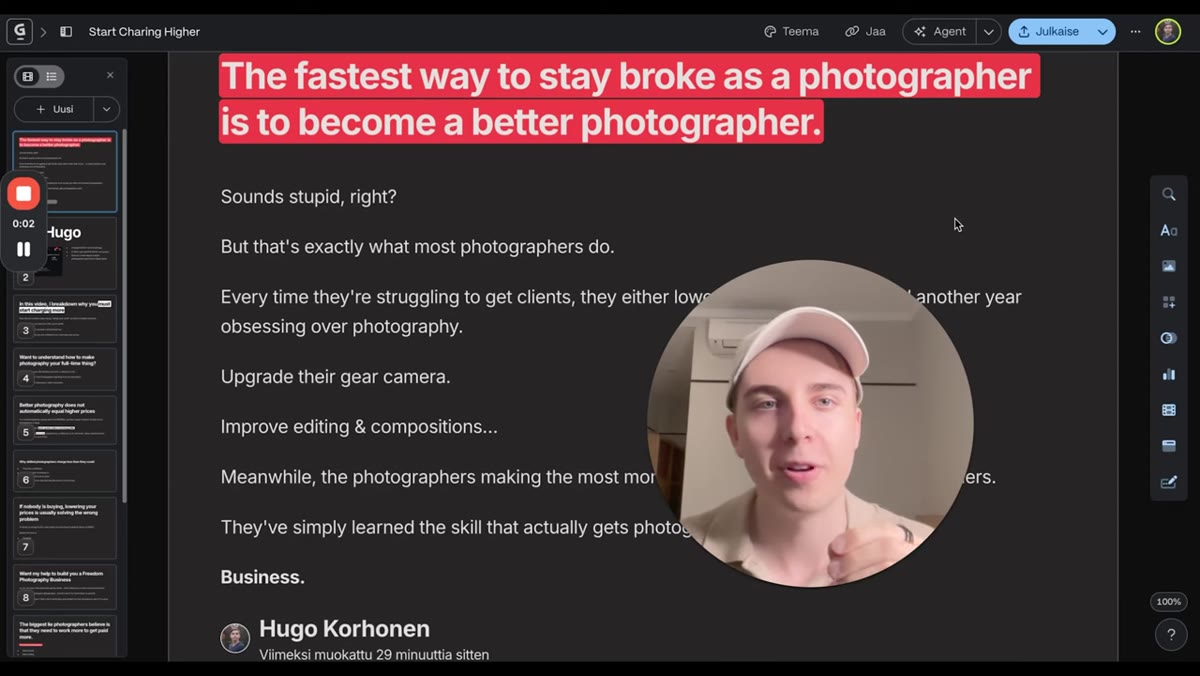 Text on screen: “The fastest way to stay broke as a photographer”
Hugo opens with a counterintuitive claim: obsessing over your photography is the fastest way to stay broke. That sounds like heresy, but the logic is sound. After a certain threshold of competence, small improvements in image quality produce almost no increase in what clients are willing to pay. What clients are actually buying is the outcome, the experience, the confidence they feel when they hire you. If you are good enough to deliver professional results, the gap between your work and someone charging three times more is probably not technical. It is business skill.
Text on screen: “The fastest way to stay broke as a photographer”
Hugo opens with a counterintuitive claim: obsessing over your photography is the fastest way to stay broke. That sounds like heresy, but the logic is sound. After a certain threshold of competence, small improvements in image quality produce almost no increase in what clients are willing to pay. What clients are actually buying is the outcome, the experience, the confidence they feel when they hire you. If you are good enough to deliver professional results, the gap between your work and someone charging three times more is probably not technical. It is business skill.
Audit yourself honestly. Are you spending your education budget on Lightroom presets and lens reviews, or on learning how to sell, communicate value, and structure client relationships? If it is the former and you are struggling to raise your rates, the tool you are sharpening is not the one holding you back.
Step 2: Understand That Low Prices Do Not Make You Safer From Rejection
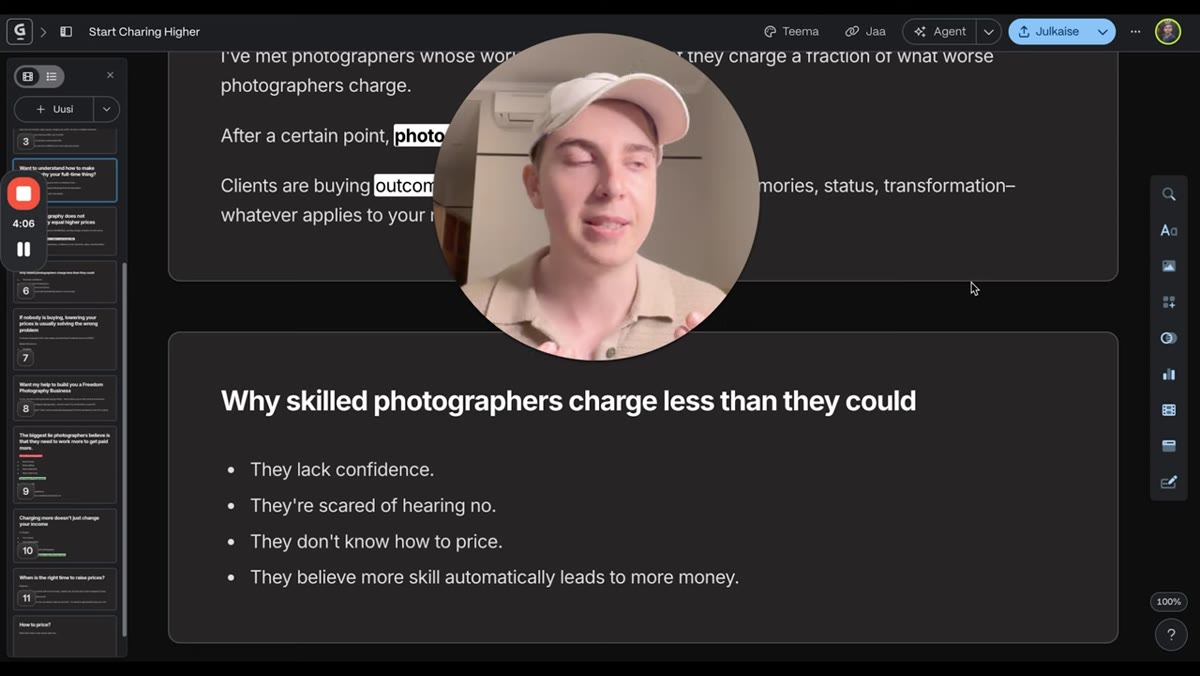 Hugo speaking to camera about fear of hearing “no”
One of the most useful reframes in this tutorial is Hugo’s point about rejection. Most photographers undercharge because they are terrified of hearing no. The logic feels airtight: lower price equals less risk of rejection. But Hugo flips it. Certain clients, specifically the clients with real budgets who are looking for a professional, are actually turned off by low prices. A rate that feels safe to you can read as amateur to them.
Hugo speaking to camera about fear of hearing “no”
One of the most useful reframes in this tutorial is Hugo’s point about rejection. Most photographers undercharge because they are terrified of hearing no. The logic feels airtight: lower price equals less risk of rejection. But Hugo flips it. Certain clients, specifically the clients with real budgets who are looking for a professional, are actually turned off by low prices. A rate that feels safe to you can read as amateur to them.
Think about the last time you hired someone for a service. If one provider quoted half of what everyone else did, did it feel like a bargain, or did it make you nervous? Premium buyers think the same way. Charging less can disqualify you from the work you actually want.
Step 3: Build the Confidence to Say Your Price Without Flinching
 Hugo explaining that confidence changes how prices land with clients
Hugo is blunt about this: if you cannot say your price with confidence, the conversation is already lost. Confidence is not arrogance, it is the signal that you believe the exchange is fair. Clients read hesitation as uncertainty, and uncertainty makes them feel like they are taking a risk on you.
Hugo explaining that confidence changes how prices land with clients
Hugo is blunt about this: if you cannot say your price with confidence, the conversation is already lost. Confidence is not arrogance, it is the signal that you believe the exchange is fair. Clients read hesitation as uncertainty, and uncertainty makes them feel like they are taking a risk on you.
Practice your pricing out loud. Seriously, say it to your bathroom mirror, say it to a friend, role-play the conversation until the number feels neutral in your mouth. I keep a notes file with my current packages and I review it before every consultation so the numbers are fresh and automatic. When a prospective client asks what I charge, I want the answer to come out the same way I would tell someone what time it is: matter-of-fact, no apology attached.
Step 4: Shift From “Charge Your Worth” to “Communicate Your Value”
 Hugo explaining why “charge your worth” is incomplete advice
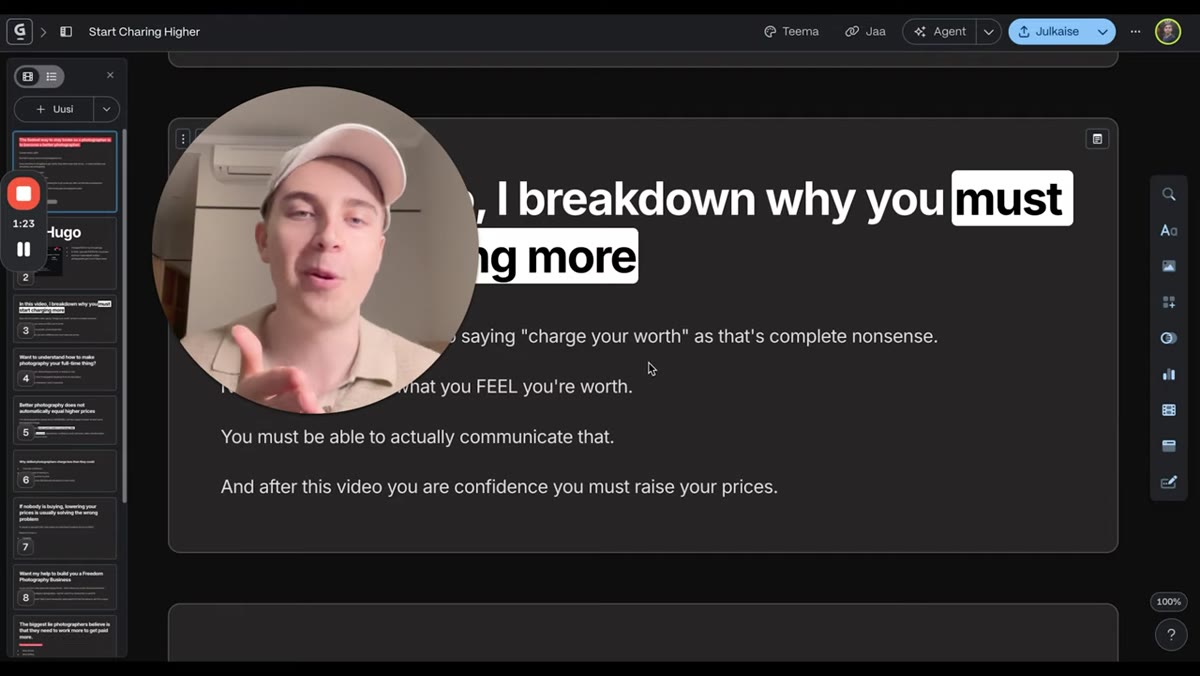
Hugo calls out the “charge your worth” advice that floats around photography communities and he is right to push back on it. Worth is invisible. Nobody writes you a check because you believe in yourself. What actually moves the needle is your ability to communicate what the client gains from working with you specifically.
Hugo explaining why “charge your worth” is incomplete advice
Hugo calls out the “charge your worth” advice that floats around photography communities and he is right to push back on it. Worth is invisible. Nobody writes you a check because you believe in yourself. What actually moves the needle is your ability to communicate what the client gains from working with you specifically.
This means getting specific in how you describe your services. Not “portrait session” but “a relaxed two-hour session designed around how your family actually moves through the world, edited to match your home’s palette, delivered in a private gallery within ten days.” The second version does not just describe a product. It describes a result, a feeling, a timeline, a standard of care. That specificity is what justifies a premium price before anyone even asks.
Step 5: Start Treating Pricing as a Business Skill, Not a Gut Feeling
 Hugo explaining that business skills are what separate high earners
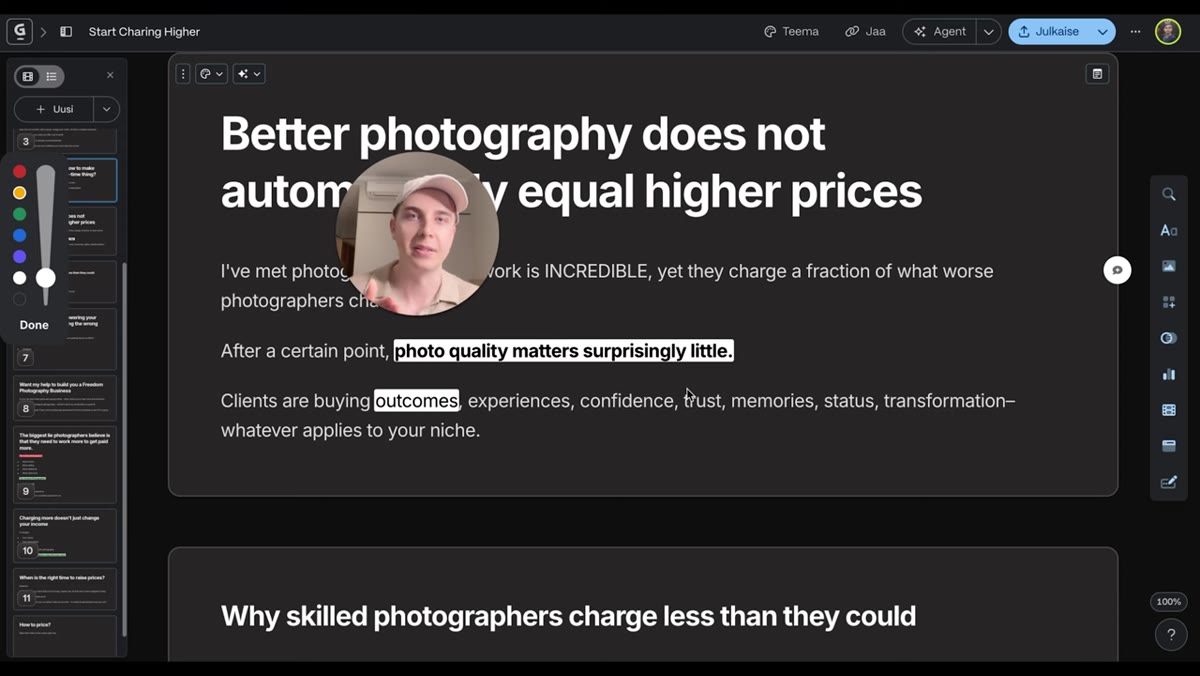
The throughline of Hugo’s tutorial is that pricing is not about confidence alone or communication alone. It is a learnable business skill that most photographers simply never invest in developing. The photographers making the most money are not always the most talented. They have learned to run a business.
Hugo explaining that business skills are what separate high earners
The throughline of Hugo’s tutorial is that pricing is not about confidence alone or communication alone. It is a learnable business skill that most photographers simply never invest in developing. The photographers making the most money are not always the most talented. They have learned to run a business.
Concretely, that means tracking your numbers. Know your cost per client acquisition, your average sale, your rebooking rate. I track mine in a simple spreadsheet that I update every month, and it tells me things my gut never would. When I can see that my portrait clients who booked from referrals spend 40% more than those who found me on Instagram, that data shapes where I focus my marketing. Decisions based on actual numbers are almost always better than decisions based on fear.
What I Would Add From My Own Studio
Hugo’s tutorial gives you the mindset shift. What I would layer on top is the operational structure that holds it in place. Raising your prices is one decision. Keeping them raised requires a system.
After I doubled my income the year I finally stopped discounting, the single biggest change was not the price increase itself. It was creating a client experience that made the price feel obvious. Every touchpoint, from the first inquiry email to the gallery delivery, communicated that this was a professional, considered, premium service. I now have a 47-item client experience checklist I run through for every booking. It sounds excessive, but it means I never have to wonder why a client referred me or why they came back. The price and the experience match, and clients feel that alignment before they ever question the number.
The single most important thing Hugo gets right is this: your pricing problem is almost certainly not a photography problem. It is a business problem. And business problems have learnable solutions.
Watch the full tutorial on YouTube and pay close attention to the section on confidence and communication. Those two things, practiced consistently, will do more for your income in the next six months than any gear upgrade you are considering.
Comments (5)
Tried this technique this morning. Game changer for real.
This should be required reading for anyone starting out.
Tried this technique this morning. Game changer for real.
Clear and practical. No fluff. Appreciate that.
This is fantastic. I've been recommending this approach to my readers too.
Leave a Comment